Embryologie ou biologie du développement
course-show.h1-title
Découvrez les mécanismes fondamentaux du développement sexuel à travers la gamétogenèse. Plongez dans la formation des cellules sexuelles (gamètes) – ovules et spermatozoïdes – et comprenez comment les génomes parentaux sont recombinés pour créer des descendants uniques. Avec une approche basée sur les modèles expérimentaux, vous apprendrez à identifier les facteurs clés et les processus de régulation qui contrôlent la différenciation sexuelle.
Introduction
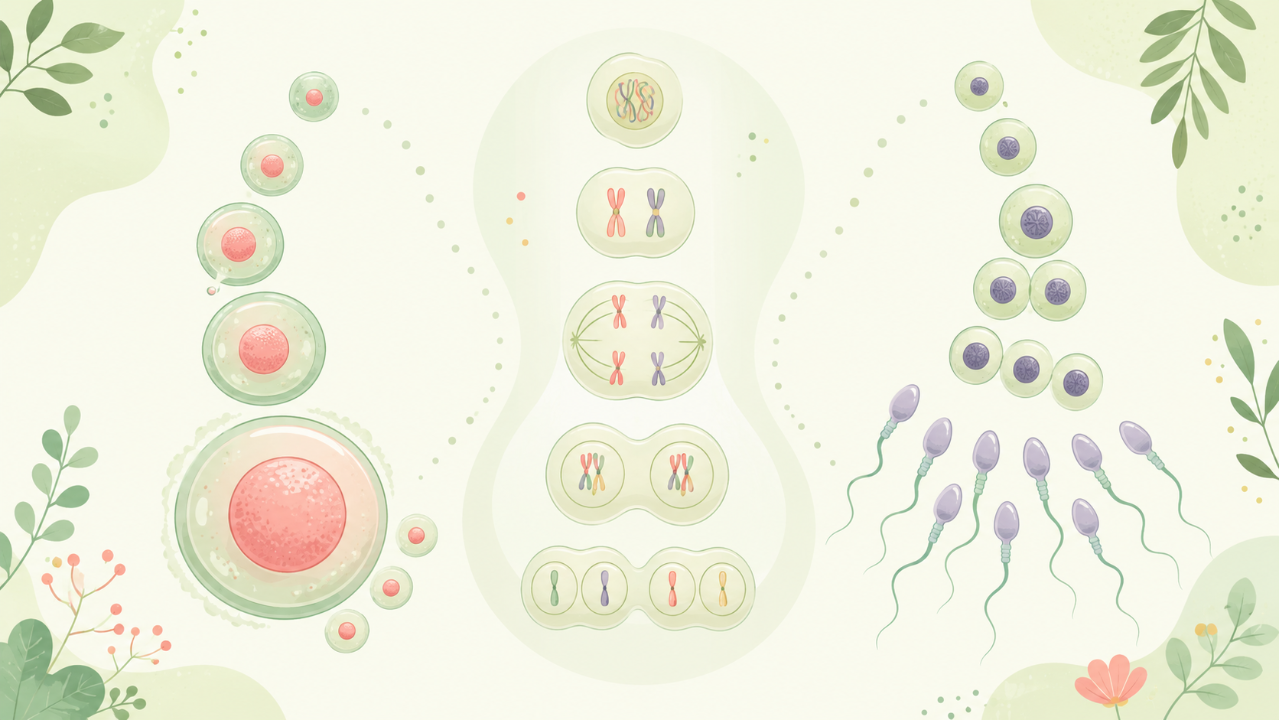
La gamétogenèse désigne le processus de production de gamètes (cellules sexuelles) chez les organismes à reproduction sexuée. Ce processus implique la méiose, un type de division cellulaire qui réduit de moitié le nombre de chromosomes et aboutit à la formation de gamètes haploïdes – ovules ou spermatozoïdes. La compréhension de la gamétogenèse est essentielle pour comprendre les mécanismes sous-jacents à la reproduction sexuée et ses implications dans divers domaines, notamment la génétique, l'évolution et la fertilité.
Présentation de la gamétogenèse
Méiose : une forme unique de division cellulaire
Stades de la méiose
- Prophase I : Cette étape est caractérisée par la synapsis des chromosomes homologues, suivie d'un enjambement et de la formation de chiasmas. La membrane nucléaire se désintègre au cours de cette phase.
- Métaphase I : Les chromosomes s'alignent sur la plaque métaphasique, prêts à être séparés.
- Anaphase I : Les chromosomes homologues se séparent et se déplacent vers les pôles opposés de la cellule.
- Télophase I : De nouvelles membranes nucléaires se forment autour de chaque ensemble de chromatides (les chromatides restent connectées au niveau des chiasmas). La cytokinèse se produit, donnant naissance à deux cellules filles possédant deux fois moins de chromosomes que la cellule parentale.
- Interkinèse : Brève interphase entre la méiose I et la méiose II, durant laquelle les cellules filles se développent et se préparent à un nouveau cycle de méiose.
- Prophase II, Métaphase II, Anaphase II et Télophase II : Ces étapes ressemblent à la mitose, les chromatides se séparant à l'anaphase II, donnant naissance à quatre cellules filles haploïdes.
Détermination et différenciation sexuelles
Les chromosomes sexuels et leur rôle
- Mammifères : Les femelles possèdent deux chromosomes X (XX), tandis que les mâles possèdent un chromosome X et un chromosome Y (XY). Lors de la méiose chez les femelles, les deux chromosomes X sont toujours maintenus ensemble en raison de leur homologie. Chez les mâles, les chromosomes X et Y ne s'apparient pas pendant la prophase I, ce qui entraîne une répartition inégale des chromosomes sexuels entre les cellules filles.
- Insectes : Certaines espèces d'insectes ont un système de détermination sexuelle XY, tandis que d'autres utilisent des systèmes tels que X0 (un seul chromosome X), des systèmes XY/autosomiques, voire plusieurs chromosomes sexuels.
- Plantes : De nombreuses espèces de plantes ont un système de détermination sexuelle XX/XY, bien que certaines possèdent des mécanismes supplémentaires comme l'auto-incompatibilité et la polyploïdie pour réguler la reproduction sexuée.
Spécification et maintenance des cellules germinales
- Cellules germinales primordiales : Le stade initial du développement des cellules germinales se produit pendant le développement embryonnaire chez la plupart des espèces, et ces cellules persistent tout au long de la vie de l'organisme chez certains animaux (par exemple, les mammifères).
- Mitose et différenciation ultérieure : Une fois que les cellules germinales primordiales atteignent leur destination (gonades), elles subissent une division mitotique pour produire davantage de cellules germinales. Chez les mâles, ces cellules se différencient en spermatogonies, tandis que chez les femelles, elles deviennent des oogonies.
- Arrêt méiotique : La méiose est arrêtée à différents stades de la vie des cellules germinales, selon l’espèce. Cela permet la synchronisation de la production de gamètes à un moment précis ou dans des conditions spécifiques (par exemple, la puberté).
Régulation de la gamétogenèse
Contrôle hormonal
- Hormone folliculo-stimulante (FSH) : Cette hormone joue un rôle crucial dans le recrutement, la croissance et la maturation des ovocytes chez les femelles. Chez les mâles, la FSH stimule la spermatogenèse dans les testicules.
- Hormone lutéinisante (LH) : La LH déclenche l’ovulation chez les femelles en induisant la rupture folliculaire, tandis que chez les mâles, elle favorise les dernières étapes de la spermatogenèse et la maturation des spermatozoïdes dans l’épididyme.
- Œstrogènes et progestérone : Ces hormones sont essentielles au développement des cellules du cumulus de l'ovocyte, à la croissance folliculaire et à la préparation de l'utérus à l'implantation chez la femelle. Chez l'homme, les œstrogènes jouent un rôle dans le maintien de la spermatogenèse.
Implications évolutives
- Reproduction sexuée : L'importance de la gamétogenèse réside principalement dans son rôle de base de la reproduction sexuée. Ce processus permet l'échange de matériel génétique entre les individus, favorisant ainsi la diversité génétique et l'adaptabilité au sein des populations.
- Méiose et recombinaison : La méiose et le crossing-over permettent le brassage des gènes entre les parents, générant de nouvelles combinaisons susceptibles de contribuer à l'innovation évolutive.
- Systèmes de détermination du sexe : La diversité des systèmes de détermination du sexe observés entre les espèces reflète la flexibilité des voies évolutives, chaque système présentant des avantages et des inconvénients spécifiques pour la survie et le succès reproductif.