
Cellular Biology
The peroxisomes
Discover peroxisomes, small cellular organelles that are key to the survival and adaptation of our cells! In this cell biology course, you'll explore their structure...
Biostatistics
Learn about Bayesian approaches in biostatistics: a probabilistic method that allows parameters to be estimated based on observed data and initial hypotheses.

The field of biostatistics is essential for the analysis and interpretation of data in biological research. One powerful approach to statistical modeling in biology is Bayesian inference, which provides a framework for updating beliefs about unknown parameters based on observed data. This course will provide an introduction to Bayesian methods in biostatistics, covering the key concepts, assumptions, and applications of these techniques.
The development of Bayesian inference can be traced back to the work of Thomas Bayes (1702-1761) and his famous theorem, published posthumously in 1763. The modern formulation of Bayesian statistics emerged in the early 20th century, with seminal works by Ronald A. Fisher, Jerzy Neyman, and Brunswick Savage, among others. Today, Bayesian methods are widely used in various fields, including biology, medicine, engineering, finance, and social sciences.
Bayesian methods have numerous applications in biology, including:
Selecting an appropriate prior distribution is crucial in Bayesian analysis, as it reflects the researcher's beliefs about the unknown parameter. Commonly used prior distributions include:
In some cases, it may be beneficial to use informative prior distributions that reflect specific knowledge about the parameter being modeled. However, this can lead to potential biases if the prior assumptions are too strong or incorrect. It is essential to consider the underlying assumptions of the prior distribution and ensure that they are consistent with the available data and research question.
The choice of prior distribution can also affect model fit, as it influences the shape and location of the posterior distribution. Overly informative priors can cause the posterior distribution to become overly concentrated around certain values, leading to poor model fit or biased estimates. Conversely, non-informative priors may result in wide posterior distributions that do not effectively constrain the parameter space.
The likelihood function plays a central role in Bayesian analysis by representing the probability of observing the given data for a specific value of the unknown parameter, assuming the prior distribution is true. The likelihood function is used to update the prior beliefs about the unknown parameter based on the observed data.
Bayesian methods provide a natural framework for model comparison and selection, as they allow for the direct comparison of different models based on their posterior distributions. Model comparison criteria, such as the Bayes factor or Watanabe-Akaike information criterion (WAIC), can help researchers select the most appropriate model given the available data.
The posterior distribution is a probability distribution that combines the prior and likelihood information to represent updated beliefs about the unknown parameter after observing the data. The posterior distribution provides a measure of uncertainty for the estimated parameters, allowing researchers to quantify the reliability of their results and make appropriate inferences.
Various methods can be used to estimate the posterior distribution, including:
Posterior predictive checks are a set of diagnostics used to evaluate the fit and appropriateness of the chosen model. These checks compare the predicted data under the posterior distribution with the observed data, helping researchers assess the adequacy of their models.
Markov chain Monte Carlo (MCMC) methods are a set of numerical techniques for sampling from complex probability distributions, such as the posterior distribution in Bayesian inference. MCMC algorithms simulate a Markov chain that converges to the desired probability distribution over time.
Assessing the convergence of an MCMC algorithm is essential to ensure that the simulated samples are adequately representative of the posterior distribution. Common diagnostic tools include:
Bayesian model averaging (BMA) is a technique that combines the evidence from multiple competing models to make more accurate predictions. In BMA, the posterior probabilities of each model are used to weight the contributions of each model's predictions.
Bayesian methods provide a natural framework for model comparison and selection based on the posterior distributions of the competing models. Several criteria can be used to compare and select among models, including:
In this section, we will demonstrate the application of Bayesian methods in a genome-wide association study (GWAS). We will use a simplified example to illustrate the key steps involved in Bayesian GWAS analysis.
Bayesian methods offer a powerful and flexible approach to statistical modeling in biostatistics, providing a framework for updating beliefs about unknown parameters based on observed data. By incorporating prior knowledge, accounting for uncertainty, and offering a natural way to compare models, Bayesian methods can lead to more accurate and robust analyses in various areas of biological research.
Penses-tu tout connaître de ce cours ? Ne tombe pas dans les pièges, entraine-toi à l'aide des QCM ! eBiologie recense des centaines de questions pour t'aider à maîtriser ce sujet.
Discover peroxisomes, small cellular organelles that are key to the survival and adaptation of our cells! In this cell biology course, you'll explore their structure...

Discover how our DNA replicates with each cell division in this molecular biochemistry course: "DNA Replication." You'll learn the key steps in this crucial process...
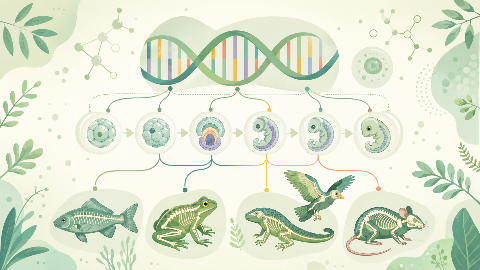
Learn about evolutionary developmental biology, the field that studies the mechanisms of embryonic development and their evolution at the molecular, cellular, and st...