Embryology or developmental biology.
course-show.h1-title
Discover the fundamental mechanisms of sexual development through gametogenesis. Delve into the formation of sex cells (gametes)—eggs and sperm—and understand how parental genomes are recombined to create unique offspring. Using an experimental model-based approach, you will learn to identify the key factors and regulatory processes that control sexual differentiation.
Introduction
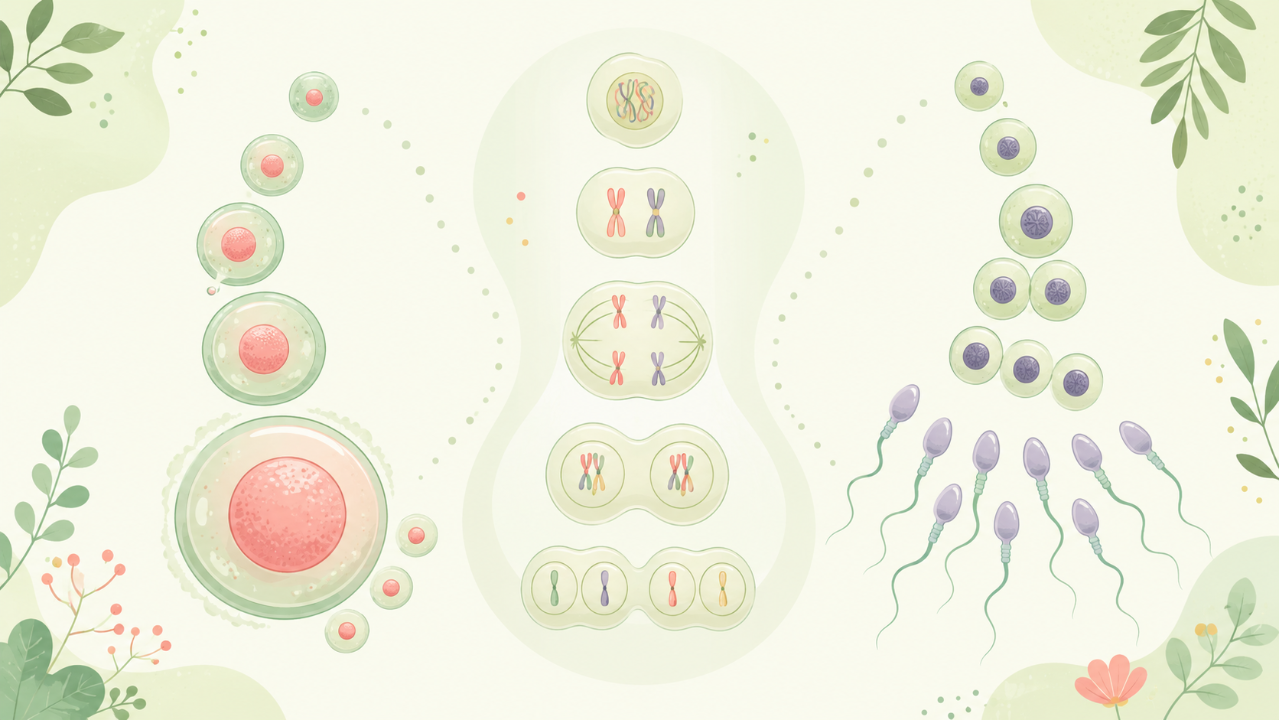
Gametogenesis refers to the process of gamete (sex cells) production in organisms that reproduce sexually. This process involves meiosis, a type of cell division that reduces the number of chromosomes by half and results in the formation of haploid gametes - eggs or sperm. The understanding of gametogenesis is crucial for comprehending the mechanisms underlying sexual reproduction and its implications in various aspects, including genetics, evolution, and fertility.
Overview of Gametogenesis
Meiosis: A Unique Form of Cell Division
Stages of Meiosis
- Prophase I: This stage is characterized by the synapsis of homologous chromosomes, followed by crossing over and chiasmata formation. The nuclear membrane disintegrates during this phase.
- Metaphase I: Chromosomes align at the metaphase plate, ready for separation.
- Anaphase I: Homologous chromosomes separate, moving towards opposite poles of the cell.
- Telophase I: New nuclear membranes form around each set of chromatids (chromatids remain connected at chiasmata). Cytokinesis occurs, resulting in two daughter cells with half the number of chromosomes as the parental cell.
- Interkinesis: A brief interphase between meiosis I and meiosis II, during which the daughter cells grow and prepare for another round of meiosis.
- Prophase II, Metaphase II, Anaphase II, and Telophase II: These stages resemble mitosis, with chromatids separating at anaphase II, resulting in four haploid daughter cells.
Sex Determination and Differentiation
Sex Chromosomes and Their Role
- Mammals: Females have two X chromosomes (XX), while males have one X and one Y chromosome (XY). During meiosis in females, the two X chromosomes are always kept together due to their homology. In males, the X and Y chromosomes do not pair during prophase I, leading to an unequal distribution of sex chromosomes between daughter cells.
- Insects: Some insect species have XY sex determination, while others utilize systems such as X0 (only one X chromosome), XY/autosomal systems, or even multiple sex chromosomes.
- Plants: Many plant species have an XX/XY system of sex determination, although some have additional mechanisms like self-incompatibility and polyploidy to regulate sexual reproduction.
Germ Cell Specification and Maintenance
- Primordial Germ Cells: The initial stage of germ cell development occurs during embryonic development in most species, with these cells persisting throughout the organism's life in certain animals (e.g., mammals).
- Mitosis and Further Differentiation: Once primordial germ cells reach their destination (gonads), they undergo mitotic division to produce more germ cells. In males, these cells further differentiate into spermatogonia, while in females, they become oogonia.
- Meiotic Arrest: Meiosis is arrested at various stages in the life of germ cells, depending on the species. This allows for the synchronization of gamete production during a specific time or under specific conditions (e.g., puberty).
Regulation of Gametogenesis
Hormonal Control
- Follicle-stimulating Hormone (FSH): This hormone plays a crucial role in the recruitment, growth, and maturation of oocytes in females. In males, FSH stimulates spermatogenesis within the testes.
- Luteinizing Hormone (LH): LH triggers ovulation in females by inducing follicle rupture, while in males, it promotes the final stages of spermatogenesis and maturation of sperm within the epididymis.
- Estrogen and Progesterone: These hormones are essential for the development of the oocyte's cumulus cells, follicular growth, and preparation of the uterus for implantation in females. In males, estrogens play a role in maintaining spermatogenesis.
Evolutionary Implications
- Sexual Reproduction: The importance of gametogenesis lies primarily in its role as the basis for sexual reproduction. This process allows for the exchange of genetic material between individuals, promoting genetic diversity and adaptability within populations.
- Meiosis and Recombination: Meiosis and crossing over enable the shuffling of genes between parents, generating novel combinations that can contribute to evolutionary innovation.
- Sex Determination Systems: The variety of sex determination systems observed across species reflects the flexibility in evolutionary pathways, with each system exhibiting unique advantages and disadvantages for survival and reproductive success.