Cellular Biology
course-show.h1-title
Discover how molecules pass through cell membranes! The "Transport Across Cell Membranes" course explores the complex dynamics underlying this transfer of vital material between the inside and outside of cells. You'll learn to identify the different types of transport (active and passive) and understand their essential role in cell life. Finally, you'll be invited to solve exercises to put your newfound knowledge into practice.
Introduction
This comprehensive academic course is designed for advanced students of biology, focusing on the critical topic of "Transport across Cell Membranes" within the discipline of Cellular Biology. The objective of this course is to provide a detailed and structured overview of the various mechanisms governing the passage of substances across cell membranes.
Background and Importance
History and Development of Transport Theory
Early Concepts: Diffusion and Osmosis
The principles of diffusion and osmosis, first described by scientists such as Fick and Claude Bernard in the 19th century, provided the foundation for understanding passive transport mechanisms.
Active Transport: The Role of Energy
With the advent of active transport, which requires energy input, the concept of a cell's ability to pump substances against their concentration gradient was introduced by scientists like Otto Meyerhof and Albert Szent-Györgyi in the early 20th century.
The Significance of Cell Membrane Transport
The efficient transport of nutrients, waste products, signaling molecules, and other crucial substances is essential for maintaining the internal environment, regulating cellular function, and facilitating intercellular communication in multicellular organisms.
Mechanisms of Transport Across Cell Membranes
Passive Transport: Facilitated Diffusion and Simple Diffusion
Facilitated Diffusion
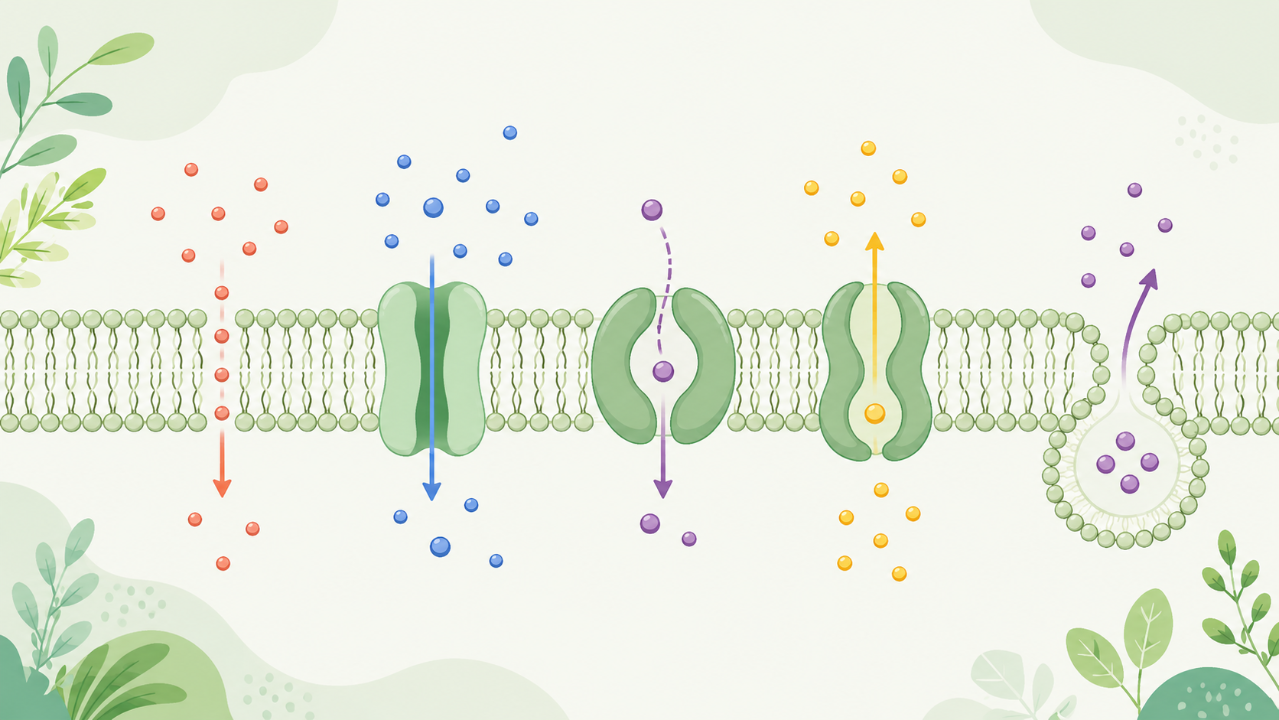
This transport mechanism allows specific ions or molecules to move across the cell membrane via transport proteins, which serve as carriers. The facilitated diffusion process is driven by the concentration gradient of the solute but does not require energy expenditure.
Examples of Transport Proteins: Glucose Transporters (GLUTs) and Na+/K+-ATPase
Simple Diffusion
Simple diffusion, also known as free diffusion, involves the movement of small, uncharged molecules across the lipid bilayer without the aid of transport proteins. The rate of simple diffusion is determined by the concentration gradient and the solubility of the diffusing molecule in the lipid environment.
Active Transport: Endocytosis, Exocytosis, and Ion Channels
Endocytosis and Exocytosis
Endocytosis and exocytosis are active transport mechanisms that involve the invagination or extrusion of plasma membrane vesicles to take up or release substances, respectively. These processes are essential for cellular communication, nutrient uptake, waste disposal, and antigen presentation.
Types of Endocytosis: Clathrin-Mediated Endocytosis, Phagocytosis, and Pinocytosis
Ion Channels
Ion channels are proteins that span the cell membrane and facilitate the passage of ions such as sodium (Na+), potassium (K+), calcium (Ca2+), and hydrogen (H+) ions. They play vital roles in nerve impulse transmission, muscle contraction, and numerous other cellular functions.
Ion Channel Classification: Voltage-Gated Channels, Ligand-Gated Channels, and Mechanically Activated Channels
Conclusion
Understanding the mechanisms governing transport across cell membranes is essential for comprehending various biological processes at both the molecular and physiological levels. The efficient regulation of transport ensures homeostasis, promotes intercellular communication, and drives the complex behaviors exhibited by living organisms.