Histology
course-show.h1-title
Discover the world of epithelia in this histology course. By learning to recognize and differentiate them, you'll gain a better understanding of the structure and function of various body tissues. You'll also learn about their cellular structure and distinctive physical and chemical properties.
Introduction
The study of epithelial tissues forms an integral part of histology, the discipline that investigates the microscopic structure of biological tissues. Epithelia are specialized tissues that line the internal and external surfaces of organs and structures in multicellular organisms, playing crucial roles in various physiological processes such as absorption, secretion, protection, and sensory perception. This course aims to provide a comprehensive understanding of the classification system used for epithelial tissues, their characteristics, functions, and significance in the broader context of histology.
Historical Background
The classification of epithelia has undergone significant evolution since its inception, reflecting advances in our understanding of cell biology, tissue structure, and tissue function. The current system of epithelial classification dates back to the pioneering work of Friedrich Gustav Johannes von Bergmann (1836-1907) and Wilhelm von Waldeyer (1836-1921), who proposed that epithelia could be categorized based on their structure, function, and origin.
Scope and Importance of Epithelial Classification
Understanding the classification of epithelia is essential for histologists, pathologists, developmental biologists, and medical researchers, as it provides a framework for analyzing and interpreting tissue samples from various organs and organisms. Moreover, it facilitates comparative studies across different species, enabling insights into the evolutionary relationships between organisms and the functional adaptations of epithelial tissues in response to selective pressures.
Classification of Epithelia
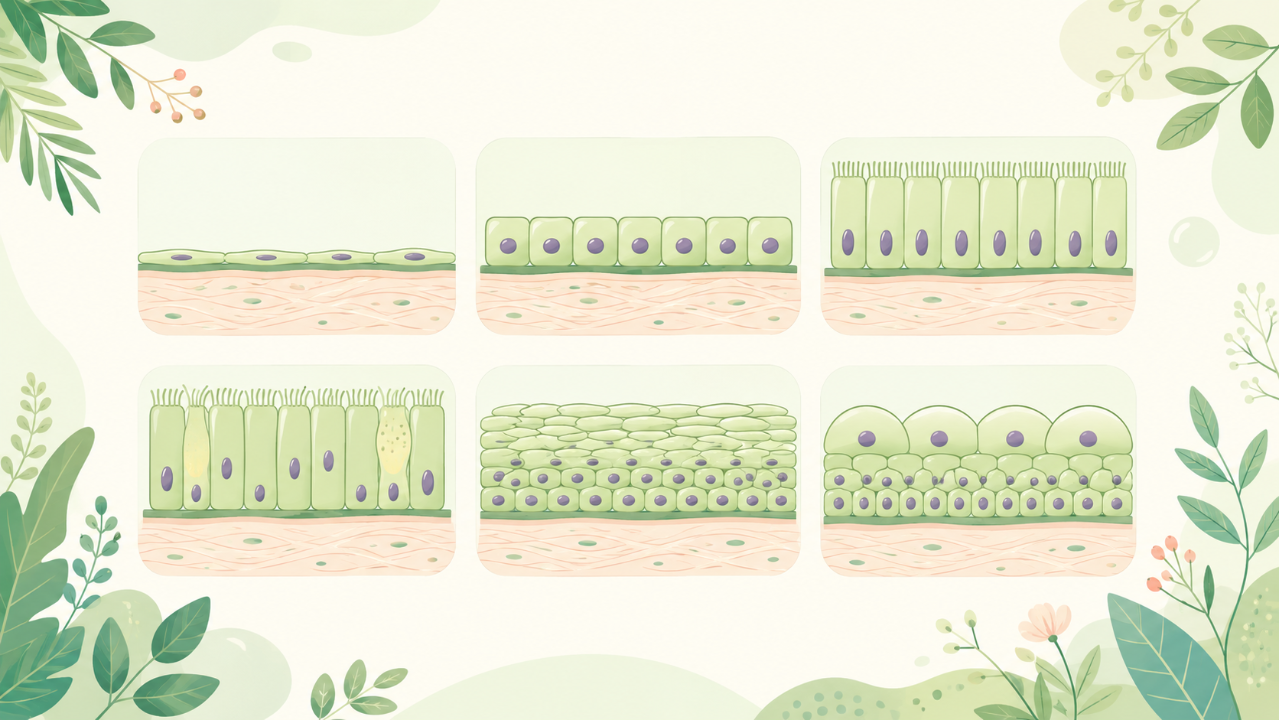
Epithelial tissues can be classified based on their thickness, degree of cellular stratification, and number of layers. The most widely accepted classification system is the one proposed by Ramon y Cajal (1852-1934), which distinguishes three main types of epithelia:
Simple Epithelia
Stratified Simple Epithelia
Stratified simple epithelia consist of multiple layers of cells, each layer being a single row of cells. These epithelia can be further classified as:
- Stratified squamous epithelium
- Stratified cuboidal epithelium
- Stratified columnar epithelium
These types differ primarily in the shape of their constituent cells, with squamous cells having a flattened and thin appearance, cuboidal cells being cube-shaped, and columnar cells being tall and slender.
Pseudostratified Simple Epithelia
Pseudostratified simple epithelia resemble stratified simple epithelia but have an additional layer of basal cells that do not extend all the way to the apical surface. The remaining layers are columnar or cuboidal in shape and are non-stratified, as they lack a clear demarcation between individual cell layers.
Transitional Epithelia
Transitional epithelia are specialized epithelia found lining organs that undergo substantial changes in volume, such as the urinary bladder. These epithelia have unique properties that allow them to accommodate these volumetric changes without tearing or rupturing. Transitional epithelium is further classified into three zones:
- Inner (Lamina lucida)
- Middle (Lamina densa)
- Outer (Lamina propria)
Each zone exhibits distinct cellular arrangements, functions, and adaptations to enable the epithelium's unique properties.
Compound Epithelia
Compound epithelia consist of two or more layers of cells, with one layer being composed of squamous, cuboidal, or columnar cells and the other layer(s) forming secretory glands, hairs, or other specialized structures. Compound epithelia can be further classified as:
- Cuboidal compound epithelium
- Columnar compound epithelium
- Stratified compound epithelium (including the hair follicle)
Each type of compound epithelium exhibits distinct morphological, functional, and developmental characteristics, reflecting their specific roles in various organs and tissues.
Conclusion
This course has provided a thorough overview of the classification system used for epithelial tissues, as well as an understanding of the key features, functions, and significance of each type of epithelium. A comprehensive grasp of epithelial classification is essential for histologists, pathologists, developmental biologists, and medical researchers, as it provides a fundamental framework for analyzing and interpreting tissue samples from various organs and organisms.