Myology
course-show.h1-title
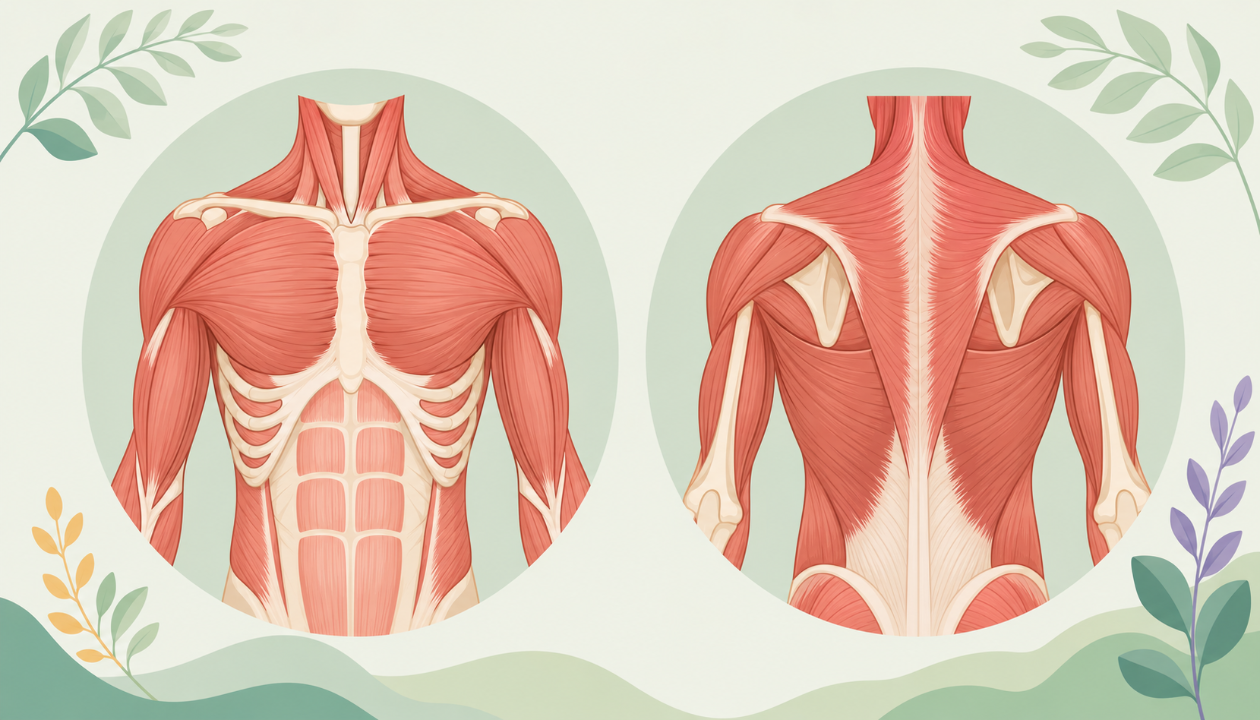
Discover the muscles of the chest and back! This course introduces you to the functions and anatomy of these key muscle groups. You'll also learn how they work together to allow the body to move efficiently.
Introduction
The human muscular system is a complex network that enables movement, maintains posture, and regulates bodily functions. This comprehensive study will delve into the essential aspects of the muscles located in the chest (pectoral muscles) and back (dorsal muscles), providing an in-depth understanding of their structure, function, and interconnections.
Overview
Understanding the muscular system requires a thorough grasp of its various components, including origins, insertions, actions, innervations, and vascular supplies. This course will elucidate these aspects for the muscles in question while highlighting their role in overall human movement and posture.
Learning Objectives
Upon completion of this course, students should be able to:
- Describe the anatomy, histology, and physiology of the pectoral and dorsal muscles.
- Identify the origins, insertions, actions, innervations, and vascular supplies of these muscles.
- Explain the role of these muscles in human movement, posture, and overall functionality.
- Understand the functional relationships between the pectoral and dorsal muscles and other muscular systems.
- Recognize the clinical implications of dysfunctions or injuries affecting these muscle groups.
Anatomy of the Chest Muscles (Pectoralis Major and Minor)
Pectoralis Major
Origins, Insertions, and Actions
Origin
The pectoralis major originates from:
- The sternum (costal and manubrium)
- The clavicle (anterior surface)
- The anterior surface of the 3rd to 5th ribs
Insertion
The pectoralis major inserts onto the greater tubercle of the humerus.
Actions
- Flexion of the arm at the shoulder joint (flexion adduction)
- Medial rotation of the forearm (internal rotation)
Innervation and Vascular Supply
Innervation
The pectoralis major is innervated by the medial (or upper) pectoral nerve, a branch of the anterior division of the brachial plexus.
Vascular Supply
The pectoralis major is supplied by:
- The thoracic acromial vessels (branch of the subscapular artery)
- The pectoral branch of the 2nd to 4th intercostal arteries
- The musculophrenic artery (branches from the axillary artery)
Pectoralis Minor
Origins, Insertions, and Actions
Origin
The pectoralis minor originates from:
- The 3rd to 5th ribs (costal cartilages)
- The coracoid process of the scapula
Insertion
The pectoralis minor inserts onto the medial (or anterior) surface of the 2nd and 3rd costal cartilages, as well as the suprasternum.
Actions
- Assists in the elevation of the ribs during inspiration (inspiration)
- Helps to depress the scapula (scapular depression)
Innervation and Vascular Supply
Innervation
The pectoralis minor is innervated by the medial (or upper) pectoral nerve, a branch of the anterior division of the brachial plexus.
Vascular Supply
The pectoralis minor is supplied by:
- The thoracic acromial vessels (branch of the subscapular artery)
- The pectoral branches of the 2nd to 4th intercostal arteries
Anatomy of the Back Muscles (Latissimus Dorsi, Rhomboids, Trapezius, Erector Spinae)
Latissimus Dorsi
Origins, Insertions, and Actions
Origin
The latissimus dorsi originates from:
- The thoracic vertebrae (T3 to T12)
- The lower 4 or 5 ribs
- The lumbar vertebrae (L1 to L5)
- The spinal fascia
- The sacrotuberous ligament
Insertion
The latissimus dorsi inserts onto the intertubercular groove of the humerus.
Actions
- Extension of the arm at the shoulder joint (extension adduction)
- Adduction of the arm at the shoulder joint
- Medial rotation of the forearm (internal rotation)
Innervation and Vascular Supply
Innervation
The latissimus dorsi is innervated by the thoracodorsal nerve, a branch of the posterior division of the brachial plexus.
Vascular Supply
The latissimus dorsi is supplied by:
- The subscapular artery (branch of the axillary artery)
- The thoracolumbar arteries (arteries from the intercostal and lumbar systems)
Rhomboid Muscles
Origins, Insertions, and Actions
Origin
The rhomboids originate from:
- The 5th and 8th vertebrae
- The spinous processes of the 2nd to 7th thoracic vertebrae
Insertion
The rhomboids insert onto:
- The medial (or inner) borders of the scapula (scapular border)
Actions
- Assist in the depression and retraction of the scapula (scapular depression, retraction)
- Help to elevate the ribs during inspiration (inspiration)
Innervation and Vascular Supply
Innervation
The rhomboids are innervated by:
- The dorsal primary rami of the cervical nerves (C5, C4)
- The dorsal primary rami of the thoracic nerves (T1 to T3)
Vascular Supply
The rhomboids are supplied by:
- The branches from the dorsal scapular artery (a branch of the subclavian artery)
- The intercostal and posterior intercostal arteries (arteries from the thoracic system)
Trapezius
Origins, Insertions, and Actions
Origin
The trapezius originates from:
- The occipital bone
- The spinous processes of the cervical vertebrae (C7 to T12)
- The lateral third of the acromion process of the scapula
Insertion
The trapezius inserts onto:
- The medial (or inner) border of the scapula (scapular border)
- The spinous processes of the cervical vertebrae (C7 to T12)
Actions
- Assist in the elevation, depression, and retraction of the scapula (elevation, depression, retraction)
- Help rotate the neck (rotation of the head)
Innervation and Vascular Supply
Innervation
The trapezius is innervated by:
- The accessory nerve (cranial nerve XI)
- The cervical plexus (C3, C4 nerves)
Vascular Supply
The trapezius is supplied by:
- The transverse cervical artery (a branch of the external carotid artery)
- The dorsal scapular artery (a branch of the subclavian artery)
Erector Spinae
Origins, Insertions, and Actions
Origin
The erector spinae originate from:
- The spinous processes of the vertebrae (cervical to lumbar regions)
- The transverse processes of the thoracic and lumbar vertebrae
Insertion
The erector spinae insert onto:
- The sacrum and coccyx (iliolumbar ligament, sacrotuberous ligament)
Actions
- Assist in the extension of the spine (extension)
- Help maintain posture by providing stability to the vertebral column (postural support)
Innervation and Vascular Supply
Innervation
The erector spinae are innervated by:
- The dorsal primary rami of the cervical, thoracic, and lumbar nerves (C1 to L5)
Vascular Supply
The erector spinae are supplied by:
- Branches from the vertebral arteries (cervical region)
- Branches from the costocervical trunk (thoracic region)
- Branches from the lumbar arteries (lumbar region)
Functional Relationships and Clinical Implications
Functional Relationships
Understanding the functional relationships between these muscles is crucial for comprehending their role in overall human movement and posture. For example, the pectoralis major works in concert with the latissimus dorsi during pulling movements such as rowing or climbing. Similarly, the trapezius coordinates with the rhomboids to stabilize the scapula during arm movements.
Clinical Implications
Dysfunctions or injuries affecting these muscle groups can lead to various impairments and discomforts. For instance, an imbalance between the pectoralis major and latissimus dorsi may result in postural problems and limited range of motion in the shoulders. Similarly, issues with the rhomboids can cause shoulder pain or even referred pain up the neck. Understanding these potential complications is essential for identifying and addressing them promptly to ensure proper recovery and overall muscular health.