Osteology
course-show.h1-title
Discover the thoracic skeleton: The sternum! This course will introduce you to the main characteristics of this key bone for protecting the heart and lungs. Learn more about its anatomy and phylogeny and discover how it plays an essential role in the organization of the thorax. Learn to identify, analyze, and understand its anatomical and phylogenetic role.
Introduction
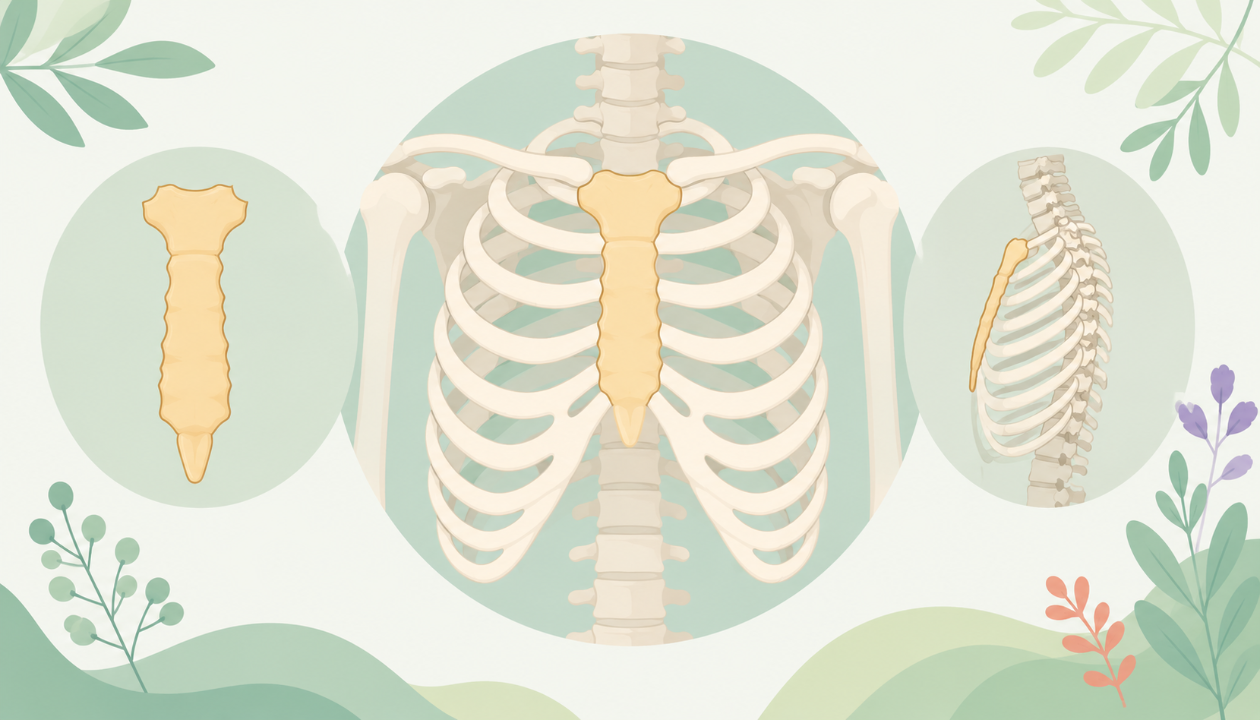
The sternum, also known as the breastbone, is a flat, flat-topped bone located in the anterior (ventral) thorax of vertebrates. In humans, it consists of three parts: the manubrium, the body, and the xiphoid process. This ossicle (bone) plays crucial roles in protection, support, and attachment of the muscles of the thorax and diaphragm, as well as forming part of the axial skeleton.
Anatomy of the Sternum
The sternum can be divided into three segments: manubrium, body, and xiphoid process. The manubrium is a large, flat, and triangular-shaped region situated superiorly. The body is the long, flat portion lying inferiorly, while the xiphoid process is a small, flexible extension at its inferio-posterior end.
The Manubrium
The manubrium of the sternum is a large, flat, and triangular-shaped region that articulates with the clavicles and first costal cartilages. It is divided into two lateral surfaces and one central (anterior) surface.
Lateral Surfaces
Each lateral surface has two facets: the suprasternal notch and the sternal angle. The suprasternal notch is a concave depression located at the superior border of the manubrium, where the anterior jugular veins pass through. The sternal angle, on the other hand, is a sharp, convex projection found at the junction of the manubrium and the body.
Central (Anterior) Surface
The central surface of the manubrium faces anteriorly and bears two pairs of costal facets: superior and inferior. Each pair consists of three facets, arranged in a horseshoe-like pattern: medial, middle, and lateral. These facets articulate with the first three costal cartilages.
The Body
The body of the sternum is the long, flat portion lying inferior to the manubrium. It has two borders, superior and inferior, as well as anterior and posterior surfaces.
Superior Border
The superior border is concave and continuous with the superior border of the manubrium. It serves as an attachment site for several muscles, including the sternomastoid, scalene, and pectoralis major muscles.
Inferior Border
The inferior border is straight and sharp, forming the anterior wall of the thorax. It articulates with the costal cartilages of the lower ribs and provides a site for muscle attachment, such as the rectus abdominis.
Anterior Surface
The anterior surface of the body bears six pairs of costal facets: superior, middle, and inferior for the second to seventh costal cartilages. Each pair consists of two facets: medial and lateral. The costal facets accommodate the costal cartilages and facilitate the movement of the ribs during respiration.
Posterior Surface
The posterior surface of the body is smooth and broad, with several processes that serve as attachment sites for various muscles. These include:
- The sternebrae (sternebral processes) - small, projecting points that articulate with the costal carilages of the lower ribs.
- The sternal end of the costal groove (costal tubercle) - a rounded eminence located at the junction between the body and xiphoid process. It serves as an attachment site for the diaphragm's crura (the muscular parts that extend from each dome of the diaphragm).
- The transverse intercostal muscles - a group of muscles that run horizontally across the posterior surface of the body, between the ribs.
The Xiphoid Process
The xiphoid process is a small, flexible extension located at the inferio-posterior end of the sternum. It has a superior surface and an inferior surface.
Superior Surface
The superior surface is smooth and serves as an attachment site for the diaphragm's crura and the abdominal muscles (including the rectus abdominis).
Inferior Surface
The inferior surface is concave and articulates with the ligamentum arteriosum, a fibrous band connecting the aorta and pulmonary trunk.
Clinical Significance
Understanding the anatomy of the sternum is essential for various medical procedures, such as thoracotomies (surgical incisions into the thorax) and cardiac surgeries. Injuries to the sternum can result in displacement or fractures, leading to chest pain, difficulty breathing, and swelling.
Conclusion
The sternum plays a vital role in the protection, support, and function of the thoracic cavity. Its anatomy is complex yet essential for understanding various medical procedures and potential injuries. Understanding the sternum's three segments - manubrium, body, and xiphoid process - will aid healthcare professionals in providing effective care and treatment to their patients.